Metro rail versus ring roads: what moves property prices
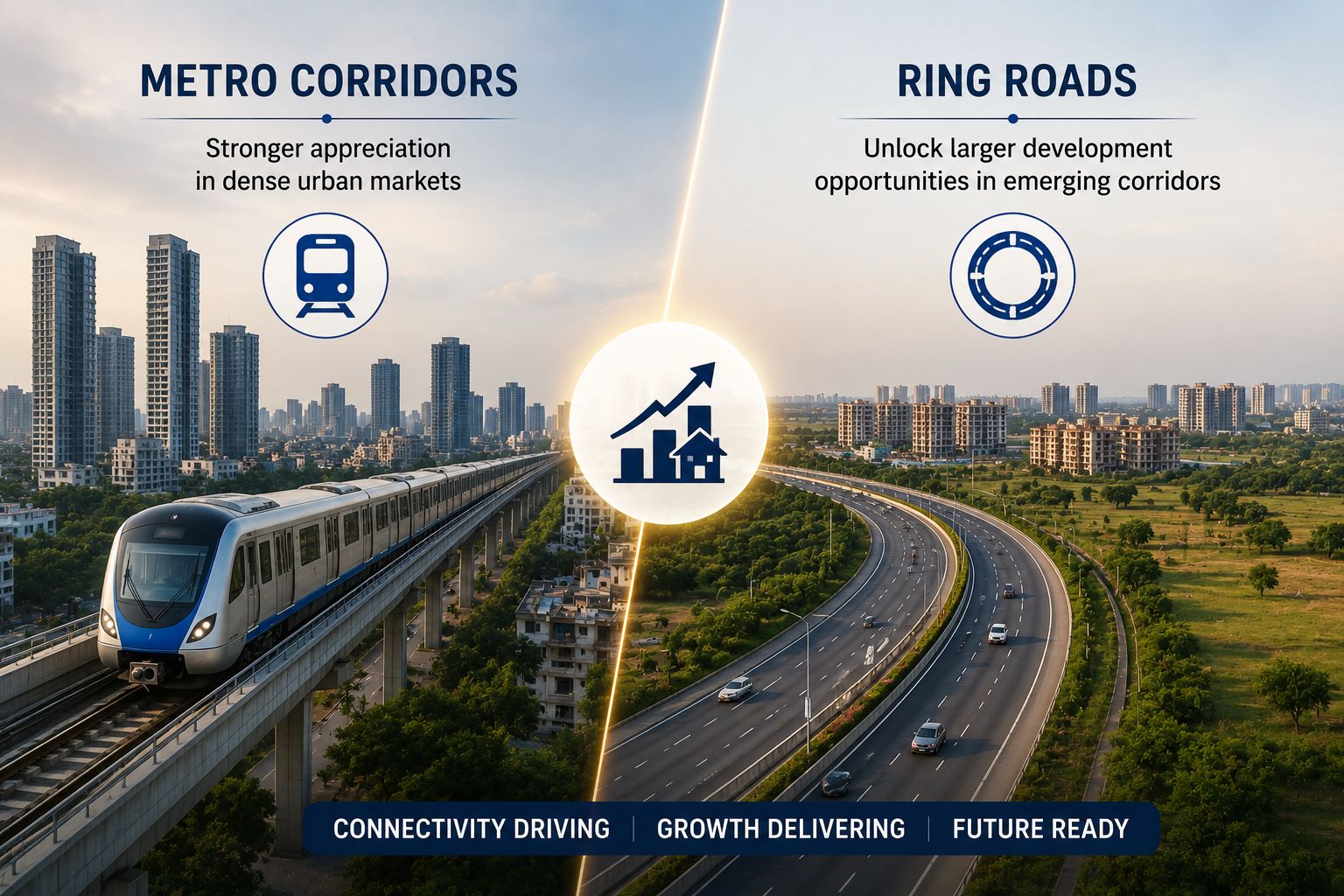
Infrastructure now often affects property prices as much as location does. Two kinds of infrastructure spending, metro rail corridors and ring roads, have time and again changed how property markets across India behave.
Both cut travel times, improve connectivity and boost economic activity. Investors often ask which one pushes prices up more. Location, market maturity, population density and the stage of urban development all shape the answer. Metro corridors tend to lift prices fast inside established urban centres. Ring roads often open entirely new growth zones and long-term development chances. Knowing what each does well helps investors decide.
How metro lines lift values
Metro rail gives fast, predictable, high-capacity travel. It shortens the trip between homes and workplaces, so locations become more appealing to homebuyers and businesses alike. Properties within walking distance of a station, or a short ride away, often see higher demand. Residents like the convenience and the lower commuting cost.
The effect is stronger in dense cities where road congestion hurts daily travel. Properties of both kinds, residential and commercial, tend to carry a premium when they stand close to metro stations rather than farther away, according to numerous studies across Indian cities.
Demand around stations
Metro lines can also create transit-oriented development. Major metro stations tend to attract retail centres, office spaces, residential towers, hotels and mixed-use developments around them. More footfall brings more commercial activity, which draws businesses and investors. This often feeds on itself and keeps prices rising.
Real estate along metro corridors in Mumbai, Bengaluru, Delhi, Hyderabad and Pune is now among the most sought-after in those cities. Investors who want rental income often find that metro-connected properties enjoy higher occupancy and stronger tenant demand.
How ring roads work differently
Metro lines improve travel inside existing urban areas. Ring roads do something else. Their main job is to relieve city centres by offering other routes around a metropolitan region.
By improving regional links, they open up large areas of land that were underdeveloped. That land can then be used for homes, commerce, industry and logistics. Suburban locations once thought too distant or hard to reach can see their land values rise sharply. Often a ring road does not just improve existing neighbourhoods; it brings an entirely new urban growth corridor into being.
Land for big projects
Land availability is a major plus of ring roads. Development follows the newly connected corridors, so developers can often get larger plots. These suit integrated townships, industrial parks, warehousing hubs, logistics centres and mixed-use communities.
Prices may rise more slowly at first than under metro-led growth. Over the long run, though, the gain can be large because development spreads over much bigger areas. Hyderabad, Bengaluru, Pune, Ahmedabad and Nagpur have all seen major real estate growth driven by ring roads. For long-term investors, these emerging corridors can offer a chance to enter before prices climb sharply.
Speed versus staying power
Metro infrastructure generally brings quicker price gains. It directly improves the daily commute of people who already live in the area. The effect is often visible soon after a project is announced. Prices then rise further as construction advances and stations open. Immediate connectivity is something residential buyers, tenants and businesses will usually pay a premium for.
The result is that demand tends to grow faster in metro-driven markets, with stronger rental yields and more rapid capital appreciation. That suits short- to medium-term investors.
Ring roads usually create value over a longer period. Rather than helping a few neighbourhoods, they affect whole urban regions. Land use changes as the infrastructure matures, with employment hubs emerging and new residential communities being established. Over time these areas can become major urban centres themselves. Investors with a long horizon often gain by entering early, while prices are still fairly affordable. The gains take longer, but they can be large.
The picture in the Mumbai region
The Mumbai Metropolitan Region shows both models at work. Housing demand and property values are already being influenced by metro lines across Mumbai, Thane, Navi Mumbai and Mira-Bhayandar. At the same time, major road projects are opening new growth corridors across the region. They include the Mumbai Trans Harbour Link, the Coastal Road, the Virar-Alibaug Multimodal Corridor and various regional connectivity projects.
Areas that gain from both metro links and regional roads are likely to see especially strong long-term appreciation. Better mobility together with more room to develop often drives real estate growth.
Which one wins?
Because the two serve different purposes, no one answer fits every case. Metro corridors generally bring:
- Faster price appreciation
- Higher rental demand
- Stronger commercial activity
- Better results in established urban markets
Ring roads generally bring:
- Larger land value creation
- New development opportunities
- Township and industrial growth
- Stronger long-term expansion potential
Investors who want immediate demand and rental income may find metro-connected locations more useful. Those who aim for long-term capital gains in emerging corridors may find ring-road developments more rewarding. Where both kinds of infrastructure intersect, the strongest investments are often to be found.
Sandeep Sadh's view
Sandeep Sadh said: "Metro corridors and ring roads should not be viewed as competing investments but as complementary growth drivers. Metro projects typically create faster appreciation in mature urban markets, while ring roads unlock entirely new development zones. The most successful real estate investments are often located where high-quality public transport and regional road connectivity come together."